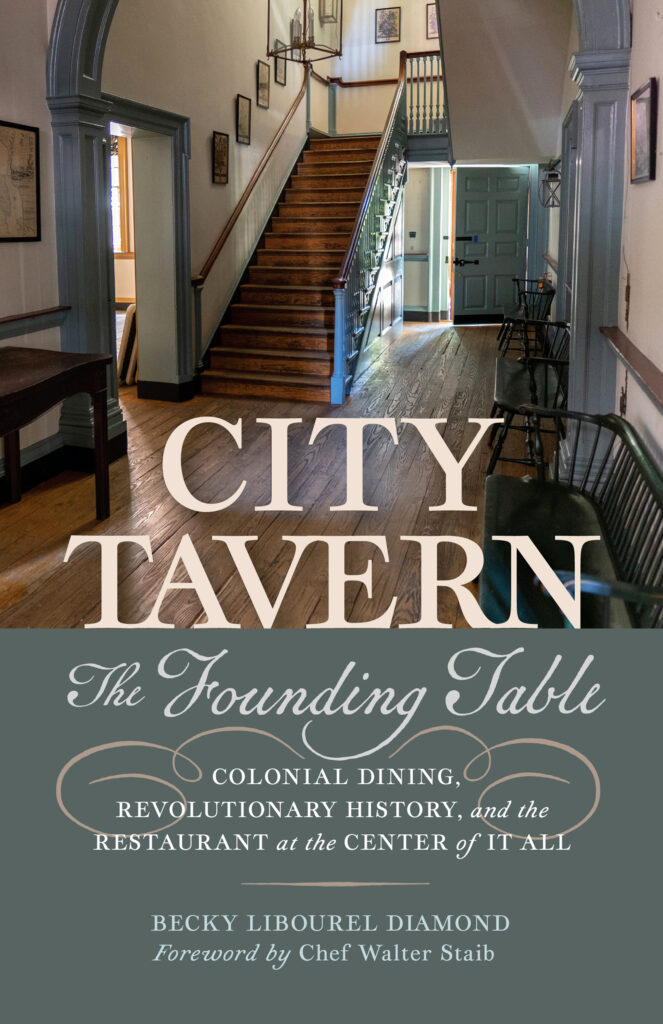
Several blocks from Independence Hall, City Tavern was a hub of life in colonial Philadelphia and its dining table an important political and social meeting place. Like George Washington’s “Rising Sun” chair and the desk where the Declaration of Independence was signed, the tavern table, and the patrons, meals, and discussions it witnessed, captures the imagination. From America’s early years, taverns were vital in urban spaces for sharing news, making business deals, holding club meetings, and discussing political issues. When a movement toward independence from Great Britain began to take hold in the eighteenth century, the central seaboard city of Philadelphia became a popular meeting location. By the 1770s, its residents saw the need for a grand, new tavern that could provide food and drink, overnight accommodations, and space for larger political and business discourse as well as social and cultural activities. Built through a subscription model funded by fifty-three of Philadelphia’s wealthiest and most socially connected men, City Tavern soon became an important meeting place for political discussion. When the Continental Congress convened in Philadelphia, City Tavern was designated as a neutral spot for delegates to make connections, solicit opinions, and offer off-the-record thoughts and solutions—all over a pint of ale or glass of Madeira. This important role continued throughout the Revolution and beyond. Many of the founding fathers dined there, and George Washington even used it briefly as his headquarters. The tavern also became a social center for music, dancing, and festive dinners.
City Tavern: The Founding Table—Colonial Dining, Revolutionary History, and the Restaurant at the Center of it All views this crucial time in America’s history through the tavern’s lens. Here the reader can follow history as it unfolds from the unique perspective of the dining table, from the decision to break from England and the prosecution of the war to Constitutional debate and the grand banquet Washington enjoyed at City Tavern in 1789 as he passed through Philadelphia on the way to his presidential inauguration in New York City. Throughout, the business of an eighteenth-century tavern is described in detail along with the food and drink enjoyed by customers at the crossroads of the American Revolution. Illustrated with period images, City Tavern provides a unique perspective on an extraordinary part of our nation’s history.
Photo: Heather Raub, FrontRoom Images
Becky Libourel Diamond is a food writer, librarian, and research historian. She is the author of two cookbooks, The Gilded Age Cookbook and The Gilded Age Christmas Cookbook, and two books of culinary history, The Thousand Dollar Dinner and Mrs. Goodfellow: The Story of America’s First Cooking School. She holds a bachelor’s degree in journalism from Rider University and a master’s of library and information science from Rutgers University. She has worked as a business librarian at Rutgers–New Brunswick since 2020.
Praise for City Tavern:
“Becky Diamond’s City Tavern is a thoroughly enjoyable and enlightening behind-the-scenes look at a little-known institution that played a significant role in the early development of the United States. Page by page in this well-researched and firmly grounded account, she demonstrates how the Tavern’s spirit of cordiality and conviviality set the stage for public cooperation, as America’s founders worked together to hammer out the shape of the nation we live in today.”—Robert N. Fanelli, author of Lydia’s Tale: The Mystery of Lydia Darragh, Irish Quaker, Patriot Spy